
Home / Clear Lake, Friendswood & League City
Bay Area Houston, mapped.
Clear Lake, Friendswood, and League City — the south Houston bay-area triangle anchored by NASA Johnson and Galveston Bay. CCISD vs. FISD schools, waterfront-versus-inland pricing, hurricane and flood considerations, and what makes each city distinct.



What the Bay Area Is
Greater Houston’s aerospace and Bay submarket.
The Bay Area covers southeast Greater Houston along I-45 South, from roughly Beltway 8 down to League City and out east to Galveston Bay. The defining institution is NASA Johnson Space Center in Clear Lake, with the broader aerospace and petrochemical workforce shaping housing demand across three school districts (Clear Creek ISD, Friendswood ISD, and pockets of others). Clear Lake is the original NASA suburb. Friendswood is a separate city with its own ISD. League City is the fast-growing northern Galveston County corridor between the two. Together they form Houston’s most established Bay-adjacent submarket.
What It Is
Three connected but distinct municipalities along I-45 South. Clear Lake City (unincorporated Harris County, 77058) was built for the NASA workforce starting in the 1960s. Friendswood (incorporated city, mostly 77546, partial Harris/Galveston split) is a separate ISD with its own city identity. League City (Galveston County, 77573) is the fastest-growing of the three, with newer master-planned communities and a wider price band. The trio shares the I-45 spine, Galveston Bay proximity, and a strong aerospace-and-engineering workforce.
What It Isn’t
This is not one market. Clear Lake City and Friendswood trade on schools and established trees; League City trades on newer construction and value. Bay-front and lake-front pockets (Nassau Bay, El Lago, Taylor Lake Village, Seabrook, Kemah) trade on water access. Inland League City trades on master-planned amenities and CCISD schools. The submarket is also not Inner Loop — it’s suburban, car-dependent, and a real 30–45 minute commute to downtown Houston.
Who It’s For
NASA, aerospace, and petrochemical professionals who work in the Bay Area or along the I-45 industrial corridor. Families prioritizing Clear Creek ISD or Friendswood ISD school zoning. Boaters and sailors who want practical access to Galveston Bay or Clear Lake. Out-of-state families relocating for engineering and energy jobs who want established suburbs with mature trees, real square footage, and meaningful community identity.
Active in Clear Lake · Friendswood · League City, Texas
Homes for sale in Clear Lake · Friendswood · League City, right now.
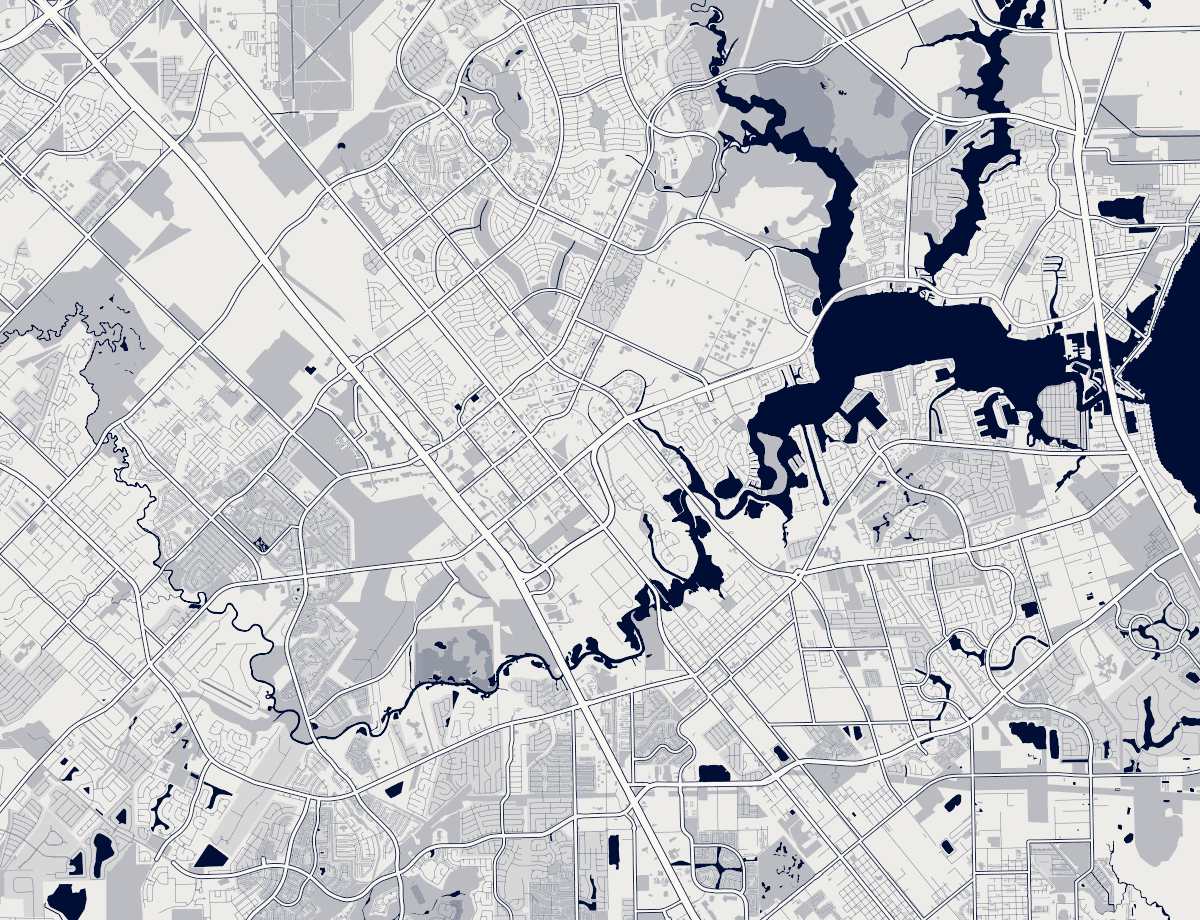
A look at what’s active in Clear Lake · Friendswood · League City today, with prices that range widely by neighborhood. Open the live map any time to see every home.
 Open the live Clear Lake · Friendswood · League City map
Orientation only. Areas are approximate, not exact listing locations.
Newest active single-family listings in Clear Lake · Friendswood · League City per the Houston Association of REALTORS® MLS. The map is for orientation only, not live listing positions. Base map © OpenStreetMap contributors, © CARTO.
By the Numbers
Bay Area market, plain language.
Bay Area medians vary widely by municipality and sub-area. Established Clear Lake City and central Friendswood trade higher than outer League City; bay-front and lake-front carry significant premiums. The numbers below show working bands across the three submarkets in early 2026. Flood insurance is a real line item here — budget it before writing.
Median Sale Price
~$385k–$525k
Source: HAR MLS, early 2026 (typical range — verify current at har.com). Across 77058, 77546, 77573. See the Q2 2026 Houston housing market brief for how the Bay Area tracks against Greater Houston. Friendswood tracks highest, League City lowest, Clear Lake City in the middle with high variance on water access.
New Construction
~$385k–$850k
League City master-planned communities (Westover Park, Mar Bella, Tuscan Lakes) at the entry end; Friendswood custom-build and waterfront League City at the top end. Builder incentives in League City are active — ask about rate buy-downs and closing-cost credits.
Resale Entry
~$285k–$425k
1960s–80s Clear Lake City, 1970s–90s Friendswood resale, older League City subdivisions. Mature trees, settled neighborhoods, established CCISD or FISD schools. Renovation level varies; ranchers and split-levels common in the older Clear Lake inventory.
Effective Tax Rate
2.2%–3.0%
Lower in incorporated Friendswood with established services; higher in League City MUDs paying off recent infrastructure bonds. On a $450k home, expect $10,000–$13,500/year. Flood insurance is separate and material — see the FAQ below.
Two things to verify on every Bay Area comp pull. First, flood zone and elevation. Many Bay Area homes are in FEMA-mapped flood zones or near them — the X, AE, and VE zone designation drives insurance cost and lender requirements. Two homes a few blocks apart can have very different insurance numbers. Pull the FEMA flood map and the elevation certificate on every property. Second, which ISD — Clear Lake City is CCISD, central Friendswood is FISD, League City is mostly CCISD but with FISD pockets. The district shifts pricing even within a half-mile radius. Pull the specific zoning before writing.
Inside the Bay Area
Six sub-areas, quickly.
The Bay Area is best understood sub-area by sub-area, not city by city. The six below capture most buyer demand. Each has its own character, its own water-access profile, and its own school feeder pattern.
77058 · CCISD · Established
Clear Lake City
The original NASA suburb. Built largely 1960s–80s for the Johnson Space Center workforce, with mature trees, settled streets, and a strong aerospace-and-engineering professional base. Housing skews ranchers, 2-story traditionals, and 1980s contemporary. Walking distance to NASA in the closest pockets. Clear Creek ISD with multiple feeder elementary patterns.
77546 · FISD · Family
Friendswood
An incorporated city with its own school district (Friendswood ISD). Higher elevations than most of the Bay Area, established trees, larger lots in pockets, more rural feel in west Friendswood. FISD consistently ranks among the top public districts in the Houston region. Strong family character, conservative pace of growth, well-developed downtown corridor along FM 518.
77573 · CCISD · Growth
League City
The fastest-growing of the three. Galveston County, CCISD-zoned across most of the city, with several master-planned communities (Westover Park, Mar Bella, Tuscan Lakes, Magnolia Creek, Bay Colony). Newer-build inventory dominates west of I-45; older League City along Highway 3 and east toward the Bay is more variable. Strong value play for buyers prioritizing newer construction and CCISD.
77058 / 77586 · CCISD · Waterfront
Nassau Bay / El Lago / Taylor Lake Village
Three small incorporated cities tucked between Clear Lake City and Galveston Bay. Direct water access to Clear Lake and (via Clear Lake) Galveston Bay. Boat slips, sailing culture, walkable to NASA in spots. Smaller housing inventory, higher per-square-foot pricing, very well-established. Premium for direct waterfront and canal-front lots.
77586 · CCISD · Boating
Seabrook / Kemah
Bay-facing waterfront communities at the south end of Clear Lake. Restaurants and entertainment district (Kemah Boardwalk) drive the local character. Mix of established homes, condos, and waterfront properties. Tourist traffic in season is real. Resale on direct-waterfront properties is strong; flood-zone considerations are central to underwriting.
77598 · CCISD · Commercial
Webster
Smaller residential pockets surrounded by the Bay Area’s primary commercial corridor (Baybrook Mall, NASA Bypass retail, medical district). More townhome and condo inventory than the surrounding cities. Practical for buyers who want walkable proximity to retail and the Bay Area medical center, less established than Clear Lake City or Friendswood.
Schools, Flood, & Commute
The three things every Bay Area buyer should weigh.
Bay Area buying has three operational realities that affect monthly cost and resale. None are dealbreakers — all are knowable in advance.
Two Strong School Districts
Clear Creek ISD (~42,000 students) covers Clear Lake City, most of League City, and surrounding incorporated cities — consistently strong academic and athletic outcomes, with Clear Lake HS, Clear Brook HS, Clear Falls HS, and Clear Springs HS as the major comprehensive highs. Friendswood ISD (~6,400 students) is a smaller, top-ranked district covering Friendswood proper — Friendswood HS regularly rates among the top public high schools in the Houston region. Verify the specific elementary by address — feeder patterns are precise.
Flood Zone Awareness
The Bay Area has more flood history than most Houston submarkets — Hurricane Ike (2008), Harvey (2017), and Imelda (2019) all affected the area. The upside: the flood map is well-developed and well-known. Most homes have known elevation certificates, known FEMA zone designations, and underwriting paths. Post-Ike new construction has built-in elevation. Buyers who pull the FEMA map, elevation certificate, and prior-claim history on every property can underwrite the risk confidently. See the Houston flood zone buyer guide and the hurricane prep guide.
Commute Reality
Bay Area to downtown Houston runs 30–45 minutes morning rush via I-45 South. To the Texas Medical Center: 25–40 minutes. To the Galleria: 35–50 minutes. To Galveston: 25–35 minutes south. Most Bay Area residents work locally — NASA, aerospace contractors (Jacobs, Lockheed, KBR, Boeing), Houston Methodist Clear Lake, the petrochemical corridor along Highway 146 — so the downtown commute matters less than in northern Houston suburbs. Test-drive your specific route at peak hour before writing.
Why People Pick the Bay Area
NASA jobs, real trees, and the water.
Three pulls drive most Bay Area buying. First, jobs. NASA Johnson Space Center, Jacobs, Lockheed Martin, KBR, Boeing, the broader aerospace network, Houston Methodist Clear Lake, and the petrochemical corridor along Highway 146 provide a deep, stable, well-compensated employment base. Most Bay Area residents commute under 20 minutes to work. Second, schools. Clear Creek ISD and Friendswood ISD are both consistently top-rated districts in the Houston region — FISD ranks among the top public districts in the state on multiple measures, and CCISD’s Clear Lake / Clear Springs / Clear Falls high schools rate strongly year over year.
Third, the water. Clear Lake is one of the largest landlocked recreational water bodies on the Texas coast. Sailing, boating, fishing, dockside dining, regattas, and a real maritime culture are woven into Bay Area life. Direct-waterfront homes in Nassau Bay, El Lago, Taylor Lake Village, Seabrook, and parts of League City and Kemah carry significant premiums, but the broader Bay Area inherits the water-access character through proximity. For families and professionals who want sailing or boating in their weekend life, the Bay Area is the only Greater Houston submarket that delivers it at scale.
The trade-off is candid: this is a flood-zone-aware market. Hurricane Ike (2008), Harvey (2017), and Imelda (2019) are real events in living memory here. The upside is that the map is well-known and the underwriting paths are clear — FEMA zones, elevation certificates, prior-claim history, and post-Ike construction elevation requirements give buyers concrete information to work with. The Bay Area also runs a 30–45 minute commute to downtown Houston, which matters for buyers who work in-Loop and matters less for buyers who work locally.
Bay Area FAQ
The questions Bay Area buyers actually ask.
What’s the difference between Clear Creek ISD and Friendswood ISD?
Clear Creek ISD (CCISD) is the larger of the two — ~42,000 students across Clear Lake City, most of League City, and surrounding municipalities. Multiple comprehensive high schools (Clear Lake HS, Clear Brook HS, Clear Falls HS, Clear Springs HS, Clear Creek HS) and a long-established academic reputation. Friendswood ISD (FISD) is a much smaller district (~6,400 students) covering the incorporated city of Friendswood. FISD has historically rated among the top public school districts in Texas on multiple measures — Friendswood HS is a regular top-ranked public high school. Both are strong; the choice often comes down to the specific address and the elementary feeder pattern.
How real is the flood risk in Clear Lake, Friendswood, and League City?
Real but knowable. Hurricane Ike (2008) drove storm surge into bay-front and Clear-Lake-front pockets; Harvey (2017) and Imelda (2019) drove rainfall flooding inland. The Bay Area has FEMA-mapped X, AE, and VE zones across many properties — every flood-zone designation has a known insurance path, and post-Ike new construction has built-in elevation requirements. The buyers who do well here pull the FEMA map, the elevation certificate, and the prior-claim history before writing the offer. The buyers who get burned skip those three steps. See the Houston flood zone buyer guide for the full framework.
How does NASA shape the housing market?
Significantly. Johnson Space Center employs ~10,000 civil servants and contractors directly, with another ~50,000 in the broader aerospace and engineering supply chain across the Bay Area. The workforce is engineering-heavy, well-compensated, and stable across decades. NASA program cycles (Artemis, ISS, commercial crew partnerships) drive demand in the closest sub-areas. Clear Lake City, Nassau Bay, El Lago, and parts of Friendswood and League City all see direct workforce demand. Job stability is one reason the Bay Area resale market has been historically resilient through Houston cycles.
Is Friendswood worth the price premium over League City?
Depends on what you’re buying. Friendswood typically trades $50–$150/sq ft higher than comparable League City inventory. The premium reflects FISD’s top-tier school ratings, higher elevations (less flood exposure in central Friendswood), more established trees and lot sizes, and the incorporated-city services. League City offers newer construction, broader inventory, more master-planned amenities, and lower entry pricing. Buyers prioritizing FISD or low flood-zone exposure tend toward Friendswood; buyers prioritizing newer construction and value tend toward League City. Both are CCISD-eligible in pockets — verify by address.
Can I keep a boat or sailboat at my house here?
In specific places, yes. Nassau Bay, El Lago, Taylor Lake Village, Seabrook, Kemah, and waterfront pockets of League City and Friendswood have direct or canal water access with boat slips and dock infrastructure. Lakewood Yacht Club and several private marinas serve the broader Clear Lake / Galveston Bay sailing community. Properties with private boat docks command meaningful premiums — expect $75k–$250k+ over comparable inland inventory depending on dock spec and water depth. Off-water owners typically slip-rent at one of several marinas in the area.
What’s the commute to downtown Houston / Texas Medical Center / Galleria?
From central Clear Lake / Friendswood / League City: downtown Houston is 30–45 minutes via I-45 North during morning rush. Texas Medical Center is 25–40 minutes. Galleria area is 35–50 minutes (mid-day shorter). Galveston is 25–35 minutes south on I-45. Bush Intercontinental (IAH) is 45–60 minutes via Beltway 8. Hobby Airport (HOU) is 20–25 minutes. Most Bay Area residents work locally and don’t commute these distances daily — aerospace, petrochemical, and Houston Methodist Clear Lake employment keeps most commutes under 20 minutes.
Is new construction or resale a better play in the Bay Area?
Depends on sub-area. League City new construction (Westover Park, Mar Bella, Tuscan Lakes, Magnolia Creek) offers newer finishes, builder warranties, and active builder incentives — rate buy-downs and closing-cost credits are common. Resale in Clear Lake City offers mature trees, established CCISD schools, NASA-era ranchers and traditionals, and lower entry pricing. Resale in Friendswood offers FISD schools and a settled small-city character at premium pricing. The right answer depends on schools, flood-zone considerations, and how much renovation budget you’re willing to absorb.
How does flood insurance work here, and what does it cost?
Two pieces. First, FEMA National Flood Insurance Program (NFIP) coverage — required by mortgage lenders on properties in AE or VE zones, optional elsewhere. NFIP premiums vary by elevation certificate, claim history, and zone — expect $500–$3,000+/year on most Bay Area properties in mapped zones. Second, private flood insurance is increasingly available and sometimes priced more competitively than NFIP. The elevation certificate matters — a few feet of base flood elevation can change the premium by hundreds of dollars per year. Get quotes from multiple carriers before closing.
Continue Exploring
Where to go next.
If you’re comparing Bay Area options, Pearland share related buyer logic with Bay Area buyers. For the broader process, the Houston buyer guide covers preapproval through closing, the Houston seller guide walks through pricing strategy, and the Houston investor guide handles rental and BRRRR analysis. When you’re ready, reach out — I work the Bay Area every month.
Ready to talk through the Bay Area?
I’ll pull current Houston Association of REALTORS® data on the sub-area you’re targeting, pull the FEMA flood zone and elevation certificate, verify the school district by address, and tell you honestly which sub-area actually fits your priorities and budget. No pressure, no obligation, no auto-drip.
Schedule a Bay Area Conversation