
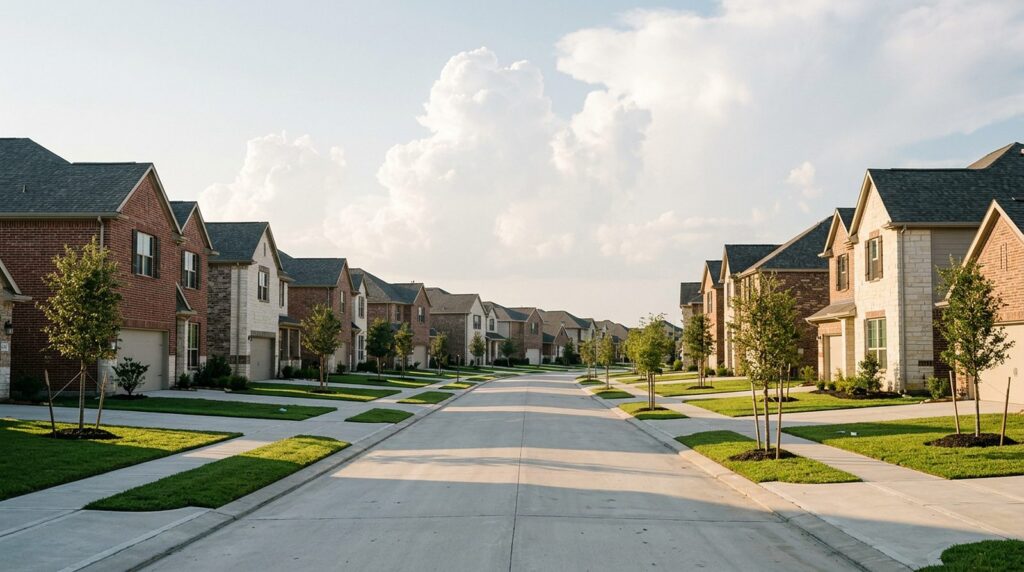
New Construction
The design center is a genuinely fun afternoon. You pick the quartz, you upgrade the backsplash, and a very good salesperson walks you through a payment estimate that works. Everything on that sheet is accurate.
I’m Eddie Weir, a REALTOR® with REMAX Signature in Greater Houston, and I want to be clear up front: this isn’t a warning about builders. Houston builds more housing than almost any metro in America, the product is often excellent, and on-site reps are good at their jobs. The issue isn’t bad faith — it’s timing. Three real costs land after you’ve moved in, and none of them are on that sheet because none of them have happened yet: the property tax bill that roughly doubles in year two, the resale ceiling while the builder is still selling your floor plan two streets over, and what a long build does to your rate lock.
Most new-build buyers are first-time buyers. These are the three I’d want explained to me before I signed.
Why does my property tax bill jump in year two?
Because Texas assesses property as it stood on January 1. If your house wasn’t finished on January 1, the appraisal district values what was there — the lot. So your first tax bill is a bill on dirt. Your second is a bill on a finished house.
Two things people assume will cushion that landing, and neither one does:
- The 10% homestead cap hasn’t started yet. The cap limits how much your appraised value can rise year to year — but per the Harris Central Appraisal District, it “begins in the second year you have a homestead exemption.” Fort Bend Central Appraisal District says the same thing: “The limitation does not go into effect until the January 1 of the following year the property qualifies for the exemption.” In year one you don’t have it.
- Even once it starts, new construction is excluded from it. The cap formula the appraisal districts publish is last year’s value + 10% + the value of new improvements. Your house is the new improvement. It gets added on top of the cap, not inside it.
So the jump is not a mistake, an over-assessment, or something to protest away. It’s the system working exactly as designed — just on a schedule that doesn’t match the one in your head.
Here’s what that looks like on a $400,000 new build. Rates are the HAR-published Greater Houston ranges; I’ve used the midpoint of each for illustration.
| Scenario | Assessed value | Rate used | Annual tax | Per month |
|---|---|---|---|---|
| Year 1 — lot only, no MUD | $90,000 | 2.25% | $2,025 | $169 |
| Year 1 — lot only, with MUD | $90,000 | 3.15% | $2,835 | $236 |
| Year 2 — finished house, no MUD, with $140,000 homestead exemption | $400,000 | 2.25% | ~$7,065 | ~$589 |
| Year 2 — finished house, with MUD, with $140,000 homestead exemption | $400,000 | 3.15% | ~$10,300 | ~$858 |
That bottom row is the one to sit with. The monthly tax line moves from about $236 to about $858 — roughly $620 a month, appearing inside a payment you already budgeted. HAR puts the typical new-construction escrow shortfall at $300 to $600 a month, which squares with this range depending on price point and district.
One caveat on the math: the $140,000 exemption applies to the school-district portion of your bill, not all of it, and Harris County adds a separate 20% exemption on its portion. I’ve approximated the blended effect rather than modeling every taxing unit. Treat the table as the shape of the problem, not a quote.
What is a MUD, and why does it make the jump bigger?
A Municipal Utility District is how a lot of Houston’s master-planned development gets built. The district issues bonds to fund water, sewer, and drainage infrastructure before the first house goes up, and residents repay those bonds through a tax on top of the county, school, and city rates.
The number matters. Per HAR, MUD rates run from $0.25 to more than $1.50 per $100 of assessed value — Cinco Ranch around $0.50, Cross Creek Ranch around $0.85, Bridgeland around $0.90, Elyson around $1.05. That’s the difference between a combined Harris County rate of roughly 2.0–2.5% without a MUD and 2.8–3.5% with one.
The genuinely good news, and it gets left out of most warnings: MUD rates decline over time as the bonds are paid down, typically across a 15–25 year arc. The catch is that a brand-new section is sitting at the very top of that curve. You’re buying at the most expensive point in the district’s life, which is precisely the trade you’re making for a new house on new infrastructure. I go deeper on how to read a district before you buy in the Houston MUD tax buyer guide, and the community comparisons in Bridgeland vs. Sienna vs. Cross Creek Ranch show how differently this lands across three master-planned options.
How do I keep year two from blindsiding me?
Four things, and they take about an afternoon total.
- Ask for the MUD rate in writing before you sign. Not “is there a MUD” — the actual current rate per $100 and the district name. Sales offices have it.
- Do the year-two math yourself. Full purchase price × the combined rate, minus your exemptions, divided by 12. Compare that to the tax line on the estimate you were handed. The gap is your future escrow shortfall, and you can start setting it aside now instead of meeting it in a letter.
- File your homestead exemption between January 1 and April 30 of the year after you close. It’s free, it takes minutes, and it also starts the clock on the 10% cap that will protect you in year three and beyond. Details in the Texas homestead exemption guide.
- Expect to protest in year two, not year one. Year one there’s nothing to argue about. Year two is the first time the district puts a number on your house, and it’s frequently based on the builder’s list price rather than what comparable homes actually closed at. County-by-county walkthroughs: Harris, Fort Bend, and Brazoria.
Going to a model home this weekend?
Send me the community first. I’ll pull the MUD rate, run your real year-two number, and tell you what to ask on site — before you’re standing at the design center.
Book a 30-minute callThe second cost: reselling while the builder is still selling
Say you buy in a section that’s 40% built out, and three years later life changes — a job, a baby, a transfer. You list. And you are not only competing with other resales. You’re competing with the builder, still selling a newer version of your floor plan two streets over, with a fresh warranty and an incentive package attached.
How big is that incentive? Big enough to name. Lennar’s most recent quarterly filing puts average sales incentives in its South Central segment — which includes Texas — at $55,000 per home delivered, or 19.1% of revenue, for the quarter ended May 31, 2026. Industry-wide, the NAHB/Wells Fargo index found 63% of builders using sales incentives in July 2026, the sixteenth consecutive month above 60%, with 37% also cutting prices by an average of 6%.
You cannot match a rate buydown. That’s the honest asymmetry, and it caps your ceiling in a way it wouldn’t in an established neighborhood where every seller is playing by the same rules.
Now the careful part, because this is where a lot of real estate content starts making numbers up. There is no defensible study quantifying how an actively selling builder affects nearby resale prices or days on market. I looked — NAR, Zillow, Redfin, the Texas Real Estate Research Center, HAR. What academic work exists on new construction and neighboring values actually points mildly the other way, finding neutral to slightly positive price effects. So I won’t hand you a percentage, because anyone who does is guessing.
What I can tell you is the shape of it: this doesn’t make the purchase wrong. It makes your timeline part of the decision. Planning seven to ten years? The section builds out, the builder moves on, the trees fill in, and you’re selling into an established neighborhood. You’re largely insulated. Real chance you move in three? Walk in knowing you may be listing across the street from an open sales office, and set your expectations on day one rather than discovering it later.
One piece of national context worth holding
For four straight quarters, the median new home in America has sold for less than the median existing home — $403,200 versus $404,600 in the first quarter of 2026, per NAHB’s analysis of Census and NAR data. That’s a reversal of the historical relationship, and it’s driven by exactly the incentives above. It’s good news if you’re buying new. It’s the thing to understand if you may be reselling into it.
The third cost: what a long build does to your rate lock
Most Houston production builds finish on schedule. Per the Census Bureau’s 2025 Survey of Construction, a built-for-sale single-family home in the South averages 5.5 months from start to completion, and about three-quarters finish within six months. A standard lock usually covers that.
The risk lives in the tail. Roughly 8% of South built-for-sale homes take more than nine months. And if you’re doing a contractor-built or semi-custom home, the picture changes materially: the South average is 9.0 months, and 19% take thirteen months or more. Nearly one in five.
Three things to understand before you lock:
Extended locks cost real money, twice
Lenders who publish their extended-lock schedules generally charge both an up-front fee and a higher rate than a standard 60-day lock. Two published schedules I reviewed price a 180-day lock at roughly 0.5% of the loan amount up front plus about a 0.50% higher rate than the 60-day price. On a $360,000 loan that’s about $1,800 up front, and the up-front fee is typically credited toward your closing costs — but only if you close inside the lock window. Those are two lenders’ published terms, not an industry standard; ask yours for their actual schedule in writing.
Blowing the lock window is the expensive part
This is the sentence buyers should read twice. On one lender’s published agreement: “If the rate lock is extended… the Up-Front Fee will be forfeited.” On another: “All deposits are forfeited, and will not be refunded, if the rate lock expires.” And when a lock has to be redone, the industry term is worst case pricing — you get the worse of your original locked rate and today’s market. You absorb a rate increase and you don’t capture a decrease. A float-down, where offered, is the one-time, fee-bearing right to re-price if rates improve before closing; it’s worth asking about specifically, because it isn’t automatic.
You get re-underwritten before you close
This one surprises people most. Fannie Mae requires that credit documents be “no more than four months old on the note date,” and the guide applies that to new construction with no exception. On a six- to twelve-month build, your paystubs, bank statements, and credit report will be pulled again. A new car loan, a furniture credit line, a job change, or a score drop taken on while you waited for drywall gets caught at the end — when you have the least room to fix it. D.R. Horton’s CFO told analysts in July 2026 that buyer qualification remains “the biggest reason for cans,” against a 20% cancellation rate. Don’t finance the furniture until you have the keys.
A word about the builder’s lender
The incentive is usually attached to it, and the rate can genuinely be excellent because the builder bought it down — D.R. Horton disclosed an average backlog rate of 4.9% for buyers using its mortgage arm as of June 30, 2026, against a market 30-year fixed of 6.58% in late July per Freddie Mac. The big three builders originate 82% to 85% of their own buyers’ loans in-house. That’s an efficient model, not a red flag. Two things worth keeping straight: if your purchase is financed with a federally related mortgage loan, the seller cannot make the sale conditional on you buying title insurance from a particular title company. A builder generally can condition an incentive on using its affiliated lender. So shop the loan regardless — the disclosure you sign says in capital letters that you’re free to — but whether you keep the incentive while closing elsewhere is a contract question, not a legal one. And note that a temporary 2-1 buydown doesn’t help you qualify: lenders must underwrite you at the full note rate. Only a permanent buydown changes that. More in Houston builder incentives and mortgage preapproval.
Frequently asked questions: new construction costs in Houston
Why did my property taxes double the second year in my new home?
Because Texas assesses property as it existed on January 1. If your home wasn’t complete on that date, year one is assessed on the lot alone; year two is assessed on the finished house. Nothing went wrong — the first bill simply wasn’t a bill on a house. Expect the escrow adjustment that follows, commonly $300 to $600 a month per HAR.
Doesn’t the 10% homestead cap protect me from that increase?
No, for two separate reasons. The cap doesn’t apply in your first year — per HCAD it “begins in the second year you have a homestead exemption.” And even once it applies, new improvements are added on top of the capped value under the appraisal districts’ own formula: last year’s value plus 10% plus new improvements. Your house is the new improvement.
How much does a MUD add to my Houston property tax bill?
Per HAR, MUD rates run from about $0.25 to more than $1.50 per $100 of assessed value — the difference between a combined Harris County rate of roughly 2.0–2.5% without a MUD and 2.8–3.5% with one. Rates decline as the district’s bonds are repaid over 15 to 25 years, but a new section sits at the top of that curve.
Should I still buy new construction in Houston?
For a lot of buyers, yes — the incentives right now are unusually strong. The point isn’t to talk you out of it. It’s to budget the year-two tax bill and think about your holding period before you sign rather than after.
Is it harder to resell a new-construction home while the builder is still selling?
You’re competing with a newer version of your home carrying a fresh warranty and an incentive package — Lennar’s Texas-region incentives averaged $55,000 per home in its quarter ended May 2026. I won’t put a number on the effect, because no credible study quantifies it. Practically: a seven-to-ten-year horizon insulates you; a possible three-year move does not.
What happens if my build isn’t finished before my rate lock expires?
You typically either pay an extension fee or re-lock at “worst case pricing” — the worse of your original rate and today’s market. Some lenders also forfeit your up-front extended-lock fee if the lock is extended or expires. Ask, in writing and before you lock, what an extension costs and whether a float-down is available.
Do I have to use the builder’s lender to get the incentive?
Often it’s conditioned on it, and federal law generally permits that. If your purchase is financed with a federally related mortgage loan, the seller cannot make the sale conditional on you buying title insurance from a particular title company. Either way, get a competing loan quote and compare total cost, not just the headline rate.
Can my loan fall apart during a long build?
It can, and qualification is the most common reason. Fannie Mae requires credit documents to be no more than four months old at closing, with no new-construction exception, so you’re re-underwritten before funding. Don’t open new accounts or finance furniture until after you close.
The bottom line
None of this is a reason to avoid new construction in Houston. It’s the best-supplied new-home market in the country and the incentives on offer right now are real. It’s a reason to walk into the design center already knowing three numbers: what your tax bill looks like in year two with the MUD included, how long you actually plan to own the house, and exactly what your lender charges if the build runs past your lock.
Get those three straight and the fun afternoon stays fun. That’s the whole point.
Thinking about a new build? Let’s run the real numbers first.
I’ll pull the MUD rate for the community, build your year-two tax and escrow estimate, and go with you to the first appointment — before you register on site.
Talk to EddieAbout Eddie Weir
I’m Eddie Weir, a top 1% REALTOR® with REMAX Signature in Greater Houston. I hold the ABR (Accredited Buyer’s Representative) and LUXE designations and bring a corporate analytics and strategy background to residential real estate. I represent buyers in new-construction communities across Harris, Brazoria, Fort Bend, and Montgomery counties — and my job is to make sure the numbers you’re shown are the complete ones. More about how I work.
“The first tax bill on a new build is a bill on a lot. Nobody is hiding that — it just hasn’t happened yet when you’re picking countertops.”
— Eddie Weir, REALTOR®, ABR, LUXE | REMAX Signature
Sources: Houston Association of REALTORS®, “Houston Property Taxes: How They Work and What You’ll Pay” (county and MUD rate ranges, escrow shortfall); Harris Central Appraisal District, Property Tax Exemptions for Homeowners (the $140,000 school-district exemption and the second-year start of the 10% cap); Fort Bend Central Appraisal District, Homestead Exemption and Homestead Cap Explained (cap formula and treatment of new improvements); U.S. Census Bureau and HUD, Survey of Construction — length of time from start to completion, 2025; Fannie Mae Selling Guide B1-1-03 (age of credit documents) and B2-1.4-04 (temporary buydowns and qualifying at the note rate); CFPB on rate locks and the CFPB RESPA FAQs; 12 U.S.C. §2608 (title insurer prohibition and treble damages) and Regulation X Appendix D (Affiliated Business Arrangement Disclosure); Lennar Corporation Form 10-Q, quarter ended May 31, 2026 (segment sales incentives, mortgage capture rate); D.R. Horton Form 10-Q, quarter ended June 30, 2026; PulteGroup Form 10-Q, quarter ended June 30, 2026; NAHB/Wells Fargo Housing Market Index, July 2026 and NAHB, new vs. existing home prices, Q1 2026; Freddie Mac Primary Mortgage Market Survey, week of July 23, 2026.
The tax table is illustrative, using midpoints of HAR’s published rate ranges and an approximated blended effect of the homestead exemption across taxing units. It is not a quote or an estimate for any specific property — your bill depends on your appraisal district, your taxing units, your MUD, and the exemptions you qualify for. Extended rate-lock terms cited are two individual lenders’ published schedules, not an industry standard; ask your lender for theirs in writing. Nothing here is legal, tax, or lending advice. Informational only, no guarantee of outcomes. If your home is currently listed with a REALTOR®, please disregard.