
LIVING IN HOUSTON
If you’re looking at Houston from California, New York, or Seattle, the prices look like a typo. A median single-family home in the Houston metro ran $331,500 in the first quarter of 2026, per the National Association of REALTORS® metro price data. The national median was $404,300. Los Angeles was $858,500. San Francisco was $1.35 million. Same country, same dollar — a house here costs a quarter of what it does on the California coast.
So the question I get from nearly every relocating buyer, usually with one eyebrow up: what’s the catch?
I’m Eddie Weir, a REALTOR® with REMAX Signature here in Greater Houston, and I’d rather give you the honest version than the brochure version. Houston homes are genuinely less expensive — for boring, structural, supply-and-demand reasons, not because something is secretly wrong. But “cheap” is also a little misleading, because two carrying costs run higher here than almost anywhere else. Let’s do both halves properly.
How cheap is Houston, actually?
Numbers first, all from the same NAR dataset (Q1 2026 median single-family price by metro), so we’re comparing apples to apples:
| Metro | Median price | vs. Houston |
|---|---|---|
| Houston–The Woodlands–Sugar Land | $331,500 | — |
| United States overall | $404,300 | +22% |
| Austin–Round Rock | $460,200 | +39% |
| New York metro | $750,000 | +126% |
| Seattle metro | $772,600 | +133% |
| Los Angeles metro | $858,500 | +159% |
| San Francisco metro | $1,350,000 | +307% |
And it’s not a one-quarter fluke. Per the Houston Association of REALTORS® MLS, the April 2026 median single-family price was $332,000 — essentially flat-to-slightly-down year over year, while the national median kept inching up. Houston has held this discount for decades.
The real reason: Houston builds more housing than anyone else
The core answer is supply. Home prices are set by scarcity, and Houston has spent fifty years refusing to make housing scarce.
1. No zoning — the only major U.S. city without it
The City of Houston has no use-zoning ordinance. That’s not folklore; it’s how the city’s own development regulations work. Development is governed by subdivision and code rules, not by maps that dictate what can be built where. When demand shifts, builders respond — without spending three years and a legal budget fighting for a rezone the way they would in coastal cities.
2. Small-lot reform that actually produced homes
Houston cut its minimum single-family lot size from 5,000 square feet to as low as 1,400 in the core. Researchers at the Mercatus Center credit that reform with tens of thousands of townhomes that simply wouldn’t exist otherwise. That’s why you see three-story townhomes filling in lots all over the Inner Loop — each one is a household that didn’t have to bid against you for a suburban resale.
3. Builders permit more homes here than in any other metro
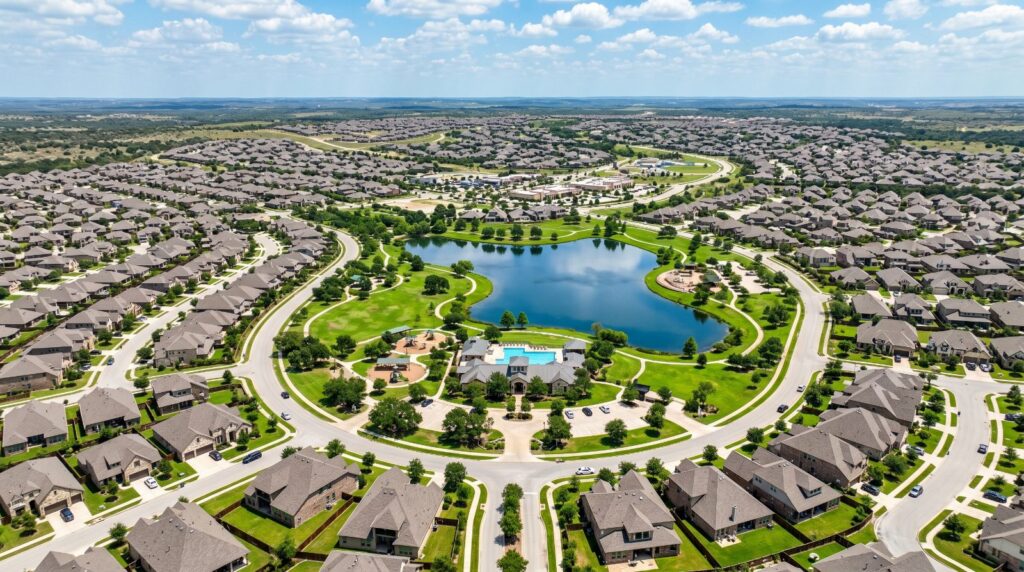
Per U.S. Census Bureau permit data, the Houston metro pulled 52,851 single-family permits in 2024 — the most of any metro in the country, ahead of Dallas–Fort Worth and Phoenix. Greater Houston also has the land to keep doing it: master-planned communities keep opening sections in Cypress, Katy, Hockley, and Waller, and the new-construction pipeline puts constant price pressure on resale sellers. When a builder twenty minutes away is offering a brand-new home with incentives, your resale negotiation gets a lot friendlier.
The short version
Houston isn’t cheap because demand is weak — the Census Bureau ranked this metro #1 in the nation for population growth, adding roughly 126,700 residents in a single year through July 2025. It’s inexpensive because supply is allowed to keep up. High demand + high supply = big, liquid, reasonably priced market.
The honest part: where Houston claws some of it back
Now the part the listing photos don’t show. Two carrying costs run high here, and if you’re moving from out of state you need them in your monthly math from day one.
Property taxes
Texas has no state income tax, and property taxes do a lot of that work. The Tax Foundation puts the effective property tax rate on Texas owner-occupied homes at roughly 1.4% — among the highest in the country. On a $330,000 home that’s in the neighborhood of $4,600+ a year before exemptions, and in some newer suburbs a MUD (Municipal Utility District) tax adds more while the district pays off its infrastructure bonds. The good news: the new $140,000 homestead exemption takes a real bite out of the school-tax portion, and you can protest your appraisal every single year. I walk buyers through the full tax picture, MUD included, on the buyer guide.
Home insurance
Houston home insurance runs roughly double the national average — Gulf Coast wind exposure is priced in. I wrote a full breakdown of why Houston insurance costs what it does and how to lower it, and flood insurance is a separate policy on top where the map calls for it (see the flood zone buyer’s guide — we check this on every house, head-on).
| Line item | Houston reality | What I tell clients |
|---|---|---|
| Purchase price | ~18% below national median, 60–75% below coastal metros | The discount is real and structural |
| Property tax | ~1.4% effective rate; MUD adds more in newer suburbs | Underwrite it; protest annually; claim your homestead |
| Insurance | Roughly 2x national average | Quote it during your option period, not after closing |
| State income tax | $0 | For most transplants this swing covers a lot of the tax/insurance gap |
Want the real number for your situation?
I build relocating buyers a full monthly-cost picture — price, tax with exemptions, insurance, MUD if any — before you ever get on a plane. No pressure, just the math.
Start with the relocation guideSo is it actually a good deal?
Here’s the cleanest way I can frame it. Per HAR’s Q1 2026 Housing Affordability Index, 42% of Houston-area households could afford the median-priced home — up from 37% a year earlier. In most coastal metros that number is in the teens or twenties. Even after the tax and insurance lines, a household earning a Houston salary can realistically own a Houston house — often a bigger, newer one than the same budget buys nearly anywhere else, with no state income tax on top.
What Houston asks in exchange is honesty about the carrying costs, a real read on flood history on a house-by-house basis, and tolerance for summer humidity. Those are knowable, manageable things — not catches.
Frequently asked questions: Houston home prices
Why are houses in Houston so much cheaper than other big cities?
Supply. Houston has no use-zoning, permissive lot-size rules, abundant developable land, and led the nation with 52,851 single-family permits in 2024 (per Census data). Builders can answer demand quickly, which keeps prices from running away the way they have in supply-constrained coastal metros.
Is something wrong with Houston homes? Is it a declining market?
No — the opposite. The Census Bureau ranked Houston the #1 metro in the country for numeric population growth (roughly +126,700 residents in the year through July 2025), and per HAR MLS, 2025 closed sales rose 3.8% to 88,634 single-family homes. Prices are lower because supply keeps pace, not because demand is missing.
What’s the catch with cheap Houston homes?
Two main ones: property taxes (~1.4% effective per the Tax Foundation, plus MUD taxes in many newer suburbs) and home insurance (roughly double the national average). Texas’s zero state income tax offsets much of that for most transplants — but run the full monthly number, not just the price.
Are Houston home prices dropping in 2026?
Slightly. Per HAR MLS, the April 2026 median single-family price was $332,000, down about 1.6% year over year, with inventory near 4.9 months — a balanced, normalizing market rather than a falling one.
Is Houston cheaper than Austin or Dallas?
Yes on Austin by a wide margin — NAR’s Q1 2026 data has Austin’s median at $460,200 vs. Houston’s $331,500, about 39% higher. Dallas also runs above Houston. Among big Texas metros, Houston is the value play.
Where are the most affordable areas in Greater Houston?
For new construction, the strongest sub-$300K activity is in areas like Hockley, Waller, and parts of Cypress — I covered them in where to find new construction under $300K. For resale value, ask me about specific corridors; “affordable” and “good fit” aren’t always the same list.
The bottom line
Houston homes are inexpensive for structural reasons that favor you as a buyer: the most permissive building environment of any major U.S. city, meeting the fastest-growing metro population in the country. The price discount is real. The fine print — taxes and insurance — is real too, and it’s manageable when you underwrite it honestly up front instead of discovering it at closing.
Thinking about a move to Houston?
I’ll put the real numbers in front of you — price, taxes, insurance, neighborhoods that fit your life — before you commit to anything.
Get the Houston relocation guideAbout Eddie Weir
I’m Eddie Weir, a top 1% REALTOR® with REMAX Signature in Greater Houston. I hold the ABR (Accredited Buyer’s Representative) and LUXE designations and bring a corporate analytics and strategy background to residential real estate. I help buyers and sellers across the entire metro — Harris, Brazoria, Fort Bend, and Montgomery counties — make decisions with the full numbers in front of them. More about how I work.
“Houston’s discount isn’t a mystery and it isn’t a defect. We just never stopped building. Buy with the tax and insurance lines underwritten honestly, and it’s one of the best value plays in American real estate.”
— Eddie Weir, REALTOR®, ABR, LUXE | REMAX Signature
Sources: NAR Metropolitan Median Area Prices, Q1 2026; Houston Association of REALTORS® MLS, April 2026 monthly report; City of Houston Planning & Development; U.S. Census Bureau Building Permits Survey (2024) and population estimates (2025 vintage); Tax Foundation — Texas; HAR Q1 2026 Housing Affordability Index; Mercatus Center research on Houston lot-size reform.
Market data per Houston Association of REALTORS® MLS and the sources above; figures are point-in-time and vary by neighborhood and property. This article is general information, not financial, tax, or insurance advice.