
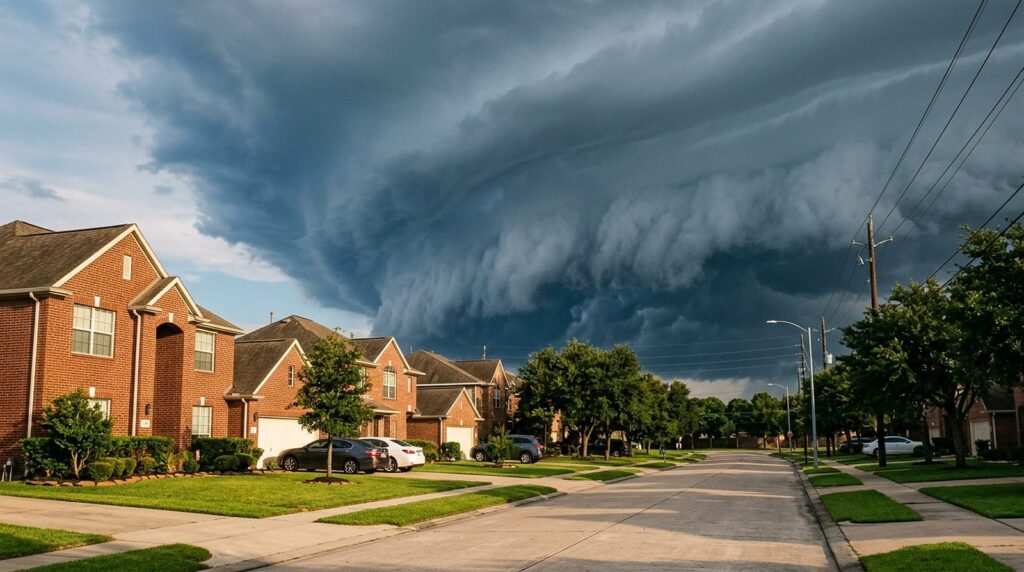
Selling in Houston
Most Houston sellers think about hurricane season the way they think about a bad weather forecast: something that might damage the house. That’s the smaller risk. The bigger one is quieter, and it happens even when the storm never comes near us.
I’m Eddie Weir, a REALTOR® with REMAX Signature in Greater Houston, and I’ve managed closings through Beryl and through several storms that never made landfall here at all. Here’s the thing sellers consistently don’t know: a storm doesn’t have to hit Houston to stall your closing. It only has to be named and in the Gulf. When that happens, insurance carriers stop writing new policies — and your buyer cannot close without one.
Hurricane season runs June 1 through November 30, and the National Hurricane Center puts the climatological peak at September 10, with most activity between mid-August and mid-October. If you’re listing or closing in the next ten weeks, here is exactly what can go wrong and how to get ahead of it.
Can a hurricane actually stop my closing?
Indirectly, and reliably. The chain works like this: your buyer’s lender requires proof of hazard insurance before it funds — Fannie Mae’s selling guide is explicit that a loan it can’t verify insurance on isn’t eligible for purchase. If the buyer can’t bind a policy, the lender can’t fund. If the lender can’t fund, you don’t close on Friday.
Nothing about that is legally a “stop.” It’s a delay — usually days, occasionally longer. But it lands on the exact date you’ve organized movers, a lease, or your own next purchase around. And there’s a sharper edge: the TREC Third Party Financing Addendum lets a buyer terminate and recover earnest money if the lender determines the property doesn’t meet underwriting requirements — and that paragraph names insurability specifically, with a deadline of the third day before closing.
Cash buyers are the exception. No lender, no insurance requirement. Not many of your buyers are cash.
What exactly triggers an insurance moratorium in Texas?
Two different things, and it’s worth knowing which applies to your house.
The Texas Windstorm Insurance Association (TWIA) has a written, mechanical rule. A moratorium takes effect when NOAA designates a storm as a hurricane and that hurricane is inside the Gulf or the box bounded by 80 degrees west longitude and 20 degrees north latitude. During it, TWIA cannot issue a new windstorm policy or increase coverage on an existing one. Renewals without an increase still go through. The moratorium lifts at 12:01 a.m. the day after TWIA’s general manager determines the storm no longer threatens the coverage area — which can be a few days or more than a week.
Note what’s not in that rule: any requirement that Texas be threatened. In September 2024, TWIA went into moratorium for Hurricane Helene — a storm that struck Florida — because Helene met the two conditions. That is the point sellers miss.
TWIA covers the 14 first-tier coastal counties, which in our market means Brazoria, Galveston, and Chambers — plus Harris County properties east of State Highway 146 that sit inside the city limits of Pasadena, Morgan’s Point, Shoreacres, Seabrook, or La Porte. Fort Bend and Montgomery counties are outside TWIA entirely.
Everyone else is covered by the second rule, which is informal but nearly universal. The Texas Department of Insurance states it plainly: “Once a named storm enters the gulf, most insurance companies, including the Texas Windstorm Insurance Association, stop selling new policies or making changes to existing ones.” That applies to a listing in Katy or The Woodlands just as much as one in League City. The specific triggers vary by carrier — some key off a named storm in the Gulf, others off a watch or warning — and they are set in individual underwriting manuals, not in state rules.
| Action | During a moratorium |
|---|---|
| Buyer binds a brand-new homeowners policy | Generally blocked — this is the one that delays closings |
| Buyer binds new windstorm coverage through TWIA | Blocked, if a hurricane is in the Gulf / defined box |
| Increasing coverage on an existing policy | Generally blocked |
| Renewing an existing policy with no coverage increase | Generally allowed |
| An already-bound policy taking effect | Unaffected — if it was bound before the moratorium, it stands |
| A cash purchase with no lender | Can close, though buying uninsured is its own decision |
The practical takeaway is a single sentence: have your buyer bind insurance early in the option period, not the week of closing. That one habit removes most of this risk from your transaction.
Thinking about listing before the season peaks?
Start with a real number. Get a free, address-specific valuation and we can talk timing from there.
Get your home’s valueWhat about flood insurance and the 30-day waiting period?
This is the piece almost everyone gets backwards, in both directions, so here it is precisely.
The default rule for a National Flood Insurance Program policy is a 30-day waiting period before coverage takes effect. Federal regulation, 44 C.F.R. §61.11(d), spells it out: buy on May 1, coverage starts May 31.
But there is a specific exception for home purchases financed with a mortgage. Under §61.11(b), when flood insurance is purchased in connection with the making, increasing, extending, or renewing of a loan, coverage is effective at the time of the loan closing — provided the policy is applied for and the premium presented at or prior to closing. So a financed buyer is not waiting 30 days. This is why the “you can’t buy flood insurance during hurricane season” panic is usually wrong for a normal financed sale.
Two things sellers should still watch:
- A cash buyer gets no exception. The rule is tied to the loan, not the sale. A cash buyer who wants flood coverage on a Houston purchase is looking at the full 30 days — something worth raising early if your buyer is paying cash and the property is in a mapped flood zone.
- The application and premium must be in at or before closing. A policy bought the Monday after funding does not qualify for the exception.
There’s also a one-day waiting period, rather than 30, when a property has just been mapped into a higher-risk zone and the owner buys within roughly a year of the map change — the regulation sets a 13-month window. If your area was remapped recently, that’s worth a call to your agent’s insurance contact. For the underlying zone questions, I’ve covered Houston’s flood-zone realities in Houston flood zone facts and the flood zone buyer guide.
The 2026 wrinkle: NFIP authorization expires September 30
This one is specific to this year, and it lands twenty days after the peak of the season.
The National Flood Insurance Program is currently authorized only through September 30, 2026. If Congress doesn’t reauthorize it, the authority to write new flood insurance contracts lapses. Existing policies continue to the end of their term — the problem is new ones, which is exactly what a buyer needs at closing.
This is not hypothetical. The NFIP lapsed from October 1 through November 12, 2025, and again briefly February 1 to 3, 2026. Congressional Research Service analysis of the 2010 lapse estimated that more than 1,400 home sale closings were canceled or delayed per day — over 40,000 a month — while the program was down.
If you own a home in a mapped flood zone and you’re planning a fall closing, that date belongs on your calendar. One useful workaround, per NAR: during past lapses, insurers have been able to assign the seller’s existing NFIP policy to the buyer by substituting names, keeping coverage in place without issuing a new policy. If you carry flood insurance, don’t cancel it the day you go under contract. It may be the thing that gets your closing done.
What happens if a storm actually hits while we’re under contract?
Your contract already answers most of this. Under the TREC One to Four Family Residential Contract, casualty loss before closing puts the obligation on the seller to restore the property to its previous condition by the closing date. If you can’t — for reasons beyond your control — the buyer may terminate and recover earnest money, extend the closing by up to 15 days, or take the property with an assignment of the insurance proceeds plus a credit for the deductible.
Then there’s the lender’s side, which is where the delay usually comes from even when the house is untouched. After a disaster, Fannie Mae puts the burden on the lender to determine whether an inspection or a new appraisal is needed before the loan is delivered, and it turns off appraisal waivers in ZIP codes inside FEMA-declared disaster areas eligible for individual assistance. Damage that affects safety, soundness, or structural integrity has to be repaired before delivery. FHA rescinded its blanket pre-endorsement disaster inspection requirement in mid-2025 and moved to a “reasonable due diligence” standard, so this is now a lender judgment call rather than an automatic mandate — but many lenders impose their own blanket re-inspection anyway.
Translation for a seller: expect a re-inspection request, budget a week or two, and keep the utilities on. A house that can’t be inspected because the power is off is a house that doesn’t close. If the appraisal is also in play, appraisals and seller financing risk covers what else can move a closing date.
Should I list now, or wait until after hurricane season?
Waiting is usually the more expensive choice, and the data is fairly clear about why.
Look at what Houston sellers actually did last year, per HAR MLS: new listings peaked at 18,359 in May 2025 and fell to 14,471 by September — a 21% drop. Closings fell from 9,058 in May to 7,399 in September. Days on market climbed from 49 in June to 59 in October.
That looks like a warning until you notice what it means competitively. Fewer sellers list in late summer and fall. Buyers who are still shopping in September are shopping seriously — relocations, school-year deadlines, expiring leases, rate-lock windows. Less competition against a more motivated pool is not obviously a bad trade for a well-prepared listing.
One honest caveat on that data: 2025 had no U.S. hurricane landfall at all. That late-summer softening is ordinary seasonality and market cycle, not storm damage. Don’t read it as evidence that hurricanes crush the fall market.
When a storm does come, the effect is sharp and short. In the week Hurricane Beryl made landfall in July 2024, HAR’s weekly snapshot showed new listings down 34.6%, pending sales down 42.7%, and closings down 27.5% year over year — while listing views on HAR.com rose 48.9%. People kept shopping from home with the power out. HAR’s own monthly report noted the storm “delayed some closings,” and by the following month activity had largely caught back up.
For what it’s worth on the risk side: NOAA’s outlook issued May 21, 2026 calls for a below-normal season — 8 to 14 named storms, 3 to 6 hurricanes, 1 to 3 major hurricanes, with a 55% chance of below-normal activity, against a 1991–2020 average of 14 named storms and 7 hurricanes. A quiet forecast is not a guarantee, and it takes exactly one storm to reach your closing table. But planning a whole selling season around a below-normal forecast is not a strong reason to sit out. More on the seasonal calculus in the best time to sell a house in Houston.
The five-minute version, if you’re under contract right now
1. Confirm your buyer has bound insurance — not quoted, bound — as early in the option period as possible. 2. If the property is in a flood zone and your buyer is paying cash, flag the 30-day NFIP wait immediately. 3. If you carry flood insurance, keep it active through closing. 4. Keep the utilities on. 5. If a storm is named, ask the lender that day what a re-inspection would require, rather than the morning of closing.
What your Texas disclosure now asks about insurance
Worth knowing before you fill out the form. The current TREC seller’s disclosure notice asks you to check whether the property is presently covered by insurance, whether it’s presently covered by windstorm insurance, and whether you have been unable to insure the property for any reason. That last one is a direct question with a real answer, and it isn’t in the statutory minimum — it’s on the form because insurability has become a live issue in Texas.
Separately, Texas Property Code §5.008 requires disclosure of present flood insurance coverage, previous flooding from a natural flood event, previous flooding from a reservoir release, whether the property sits in a 100-year or 500-year floodplain, floodway, flood pool, or reservoir, and whether you have ever filed a flood claim — including with the NFIP — or received FEMA or SBA assistance for flood damage. If the notice isn’t delivered before the contract is signed, the buyer can terminate within seven days of receiving it.
My advice is the same every time: answer it completely and early. A disclosed flood claim priced into the deal is a negotiation. An undiscovered one found during the buyer’s insurance shopping is a dead contract, and potentially worse. I broke the current form down in detail in the 2026 Texas seller’s disclosure guide.
Frequently asked questions: selling during hurricane season in Houston
Can you close on a house during a hurricane watch in Texas?
Often yes, if insurance was already bound. The obstacle isn’t the watch itself — it’s that most Texas carriers stop writing new policies once a named storm enters the Gulf, and lenders require proof of hazard insurance to fund. If your buyer bound coverage before the moratorium, the policy stands and the closing generally proceeds.
What is an insurance binding moratorium?
A temporary suspension of new policies and coverage increases when a storm threatens. TWIA’s version is triggered when NOAA designates a storm a hurricane and it is within the Gulf or the box bounded by 80°W and 20°N, and it lifts at 12:01 a.m. the day after TWIA determines the threat has passed. Most private Texas carriers apply their own similar rules based on a named storm entering the Gulf.
Does flood insurance have a 30-day wait when buying a house?
Not for a financed purchase. Federal regulation waives the 30-day waiting period when flood insurance is bought in connection with making, increasing, extending, or renewing a loan, as long as the application and premium are presented at or before the loan closing. A cash buyer with no mortgage does not get that exception and faces the full 30 days.
Should I take my Houston home off the market during hurricane season?
Usually no. Listing volume drops materially in late summer — new listings fell 21% from May to September 2025 — which means less competition for the buyers who are still actively shopping. The better move is preparing for the specific risks: early insurance binding, an accurate disclosure, and a lender who knows what a post-storm re-inspection would require.
What happens to my contract if a storm damages the house before closing?
Under the TREC residential contract, the seller is obligated to restore the property to its previous condition by the closing date. If that isn’t possible for reasons beyond the seller’s control, the buyer may terminate and receive the earnest money back, extend closing by up to 15 days, or close and take an assignment of the insurance proceeds plus a credit for the deductible.
Will the buyer’s lender require a new inspection after a storm?
Often. Fannie Mae requires the lender to determine whether an inspection or new appraisal is needed for properties in disaster areas, and it disables appraisal waivers in FEMA-declared individual-assistance ZIP codes. FHA moved from a blanket requirement to a due-diligence standard in mid-2025, but many lenders keep their own re-inspection overlay. Plan for one to two weeks and keep the utilities on so the property can be inspected.
Is the NFIP going to lapse in 2026?
The program is authorized through September 30, 2026, and Congress has repeatedly extended it — but it has also lapsed twice in the past year, most recently in early February 2026. If you’re selling a home in a flood zone with a fall closing, keep your existing policy active; during past lapses, insurers have assigned the seller’s policy to the buyer to keep coverage in place.
Do I have to disclose past flooding when selling in Texas?
Yes. Texas Property Code §5.008 requires disclosure of previous water penetration from a natural flood event, previous flooding from a reservoir release, floodplain and floodway location, any flood insurance claim you have ever filed including with the NFIP, and any FEMA or SBA flood assistance received. The current TREC form also asks whether you have been unable to insure the property for any reason.
The bottom line
Hurricane season is a transaction-management problem more than a property-damage problem. The property risk is real but statistically modest in any given year. The closing risk is near-certain to touch someone’s deal every season, and it is almost entirely preventable with three habits: bind insurance early, disclose completely, and keep the seller’s flood policy alive until funding. It belongs in the same file as every other date-driven step in a Houston sale — see the seller launch plan and how the offer and contract fit together.
Do those three things and a named storm in the Gulf becomes a news story you watch rather than a phone call you dread.
Selling this fall? Let’s build the timeline around the risk.
I’ll map your listing and closing dates against the season, coordinate insurance binding early with your buyer’s side, and make sure your disclosure is airtight before it costs you a contract.
Talk to EddieAbout Eddie Weir
I’m Eddie Weir, a top 1% REALTOR® with REMAX Signature in Greater Houston. I hold the ABR (Accredited Buyer’s Representative) and LUXE designations and bring a corporate analytics and strategy background to residential real estate. I list and sell homes across Harris, Brazoria, Fort Bend, and Montgomery counties, and I project-manage transactions the way I used to manage corporate programs — every deadline tracked, nothing discovered late. More about how I work.
“The storm that costs you a closing usually isn’t the one that hits Houston. It’s the one that gets a name while your buyer is still shopping for insurance.”
— Eddie Weir, REALTOR®, ABR, LUXE | REMAX Signature
Sources: Texas Windstorm Insurance Association, policy moratoriums; Texas Department of Insurance, TWIA Overview (June 2026); Texas Department of Insurance, “When a storm enters the gulf”; 44 C.F.R. §61.11, NFIP effective date of coverage and FEMA FloodSmart policy terms; Congressional Research Service, NFIP lapse analysis (updated February 2026); National Association of REALTORS®, NFIP expiration FAQ; Fannie Mae Selling Guide B2-3-05, Properties Affected by a Disaster and B7-3-07, Evidence of Property Insurance; HUD Mortgagee Letter 2025-19; TREC One to Four Family Residential Contract (Resale) and Third Party Financing Addendum; TREC Seller’s Disclosure Notice and Texas Property Code §5.008; NOAA 2026 Atlantic hurricane season outlook and National Hurricane Center climatology; Houston Association of REALTORS® MLS monthly reports, 2024–2026.
Insurance binding rules vary by carrier and change without notice; TWIA’s published rule is the only mechanical trigger cited here, and other carriers set their own. Nothing in this article is legal, insurance, or tax advice — confirm coverage questions with a licensed Texas insurance agent and contract questions with your attorney. Contract paragraph references are to the current promulgated TREC forms at time of writing. Informational only, no guarantee of outcomes. If your home is currently listed with a REALTOR®, please disregard.