
Selling in Houston
Every seller I meet asks some version of the same question: what should we fix before we list? And almost every seller expects the answer to involve the kitchen. It usually doesn’t.
I’m Eddie Weir, a REALTOR® with REMAX Signature in Greater Houston, and before real estate I spent my career in corporate analytics — so I’d rather show you the return data than give you a hunch. Here’s the short answer for Houston: the highest-returning projects are small, visible, and boring. A garage door replacement returns about 245% of its cost here. A midrange major kitchen remodel returns about 47%. And the single most valuable thing many Houston sellers can do isn’t on any remodeling list at all — it’s making sure the house is still insurable.
Let’s go through the actual numbers, then the four Houston-specific items that decide whether your buyer’s loan closes.
What home improvements actually pay off before you sell in Houston?
Exterior replacements, overwhelmingly. Zonda’s Cost vs. Value Report prices a fixed set of projects in 100-plus local markets and asks real estate professionals what each one adds to a sale price. In the Houston market data, the top of the list isn’t close.
| Project | Typical Houston job cost | Added resale value | Cost recouped |
|---|---|---|---|
| Garage door replacement | $4,607 | $11,307 | 245.5% |
| Manufactured stone veneer | $10,672 | $24,005 | 224.9% |
| Entry door replacement (steel) | $2,400 | $5,272 | 219.7% |
| Siding replacement (fiber-cement) | $20,148 | $22,170 | 110.0% |
| Minor kitchen remodel (midrange) | $28,300 | $30,024 | 106.1% |
| Bath remodel (midrange) | $23,503 | $17,679 | 75.2% |
| Window replacement (vinyl) | $20,991 | $14,677 | 69.9% |
| Roof replacement (asphalt shingle) | $27,519 | $18,962 | 68.9% |
| Major kitchen remodel (midrange) | $81,521 | $38,166 | 46.8% |
| Primary suite addition (midrange) | $162,563 | $48,960 | 30.1% |
| Solar power installation | $53,711 | $13,108 | 24.4% |
Look at the two highlighted rows. Spend $4,607 on a garage door and the data says you get roughly $11,300 back. Spend $81,521 gutting the kitchen and you get roughly $38,200 back — you are donating about $43,000 to the next owner’s taste.
Why does a garage door beat a kitchen?
Three reasons, and once you see them you can apply the logic to anything.
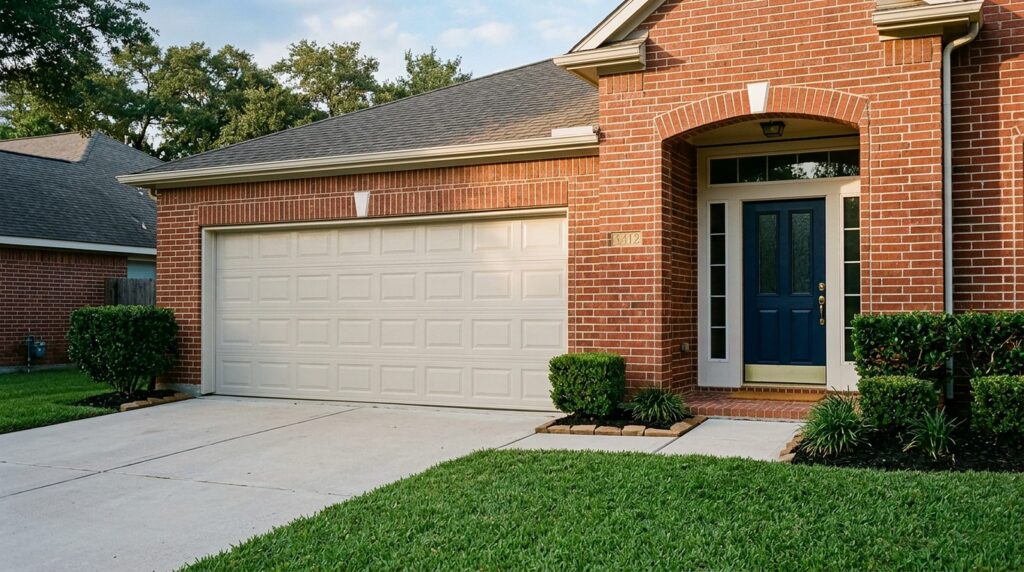
- It’s the first thing the buyer sees. On most Houston streets the garage door is 30% of the front elevation. It’s in the listing photo, and the listing photo decides whether anyone books a walkthrough at all. In NAR’s 2025 staging research, 73% of buyers’ agents said photos were “much more or more important” to their clients than they used to be.
- It reads as maintenance, not taste. A dented, sun-faded door tells a buyer the house has been let go. A clean new one tells them it hasn’t. Buyers extrapolate wildly from small signals — and they extrapolate about things they can’t see from things they can.
- Nobody’s taste is involved. Your quartz choice can subtract value from a buyer who wanted something else. A neutral new garage door can’t.
The same logic explains why a $2,400 steel entry door returns nearly 220% while $53,711 of solar returns 24.4%. Cheap, visible, universal beats expensive, invisible, and specific — every time.
The Houston item nobody puts on the ROI list: how old is your roof?
This is the one I’d put ahead of everything above, and it never shows up in a remodeling report, because it isn’t about value — it’s about whether the sale can happen at all.
Your buyer needs a homeowners policy to close. Their lender requires proof of hazard insurance, full stop. And Texas carriers have gotten strict about roof age. To take one published example, Homeowners of America’s Texas underwriting guidelines make composition roofs older than 15 years ineligible when windstorm coverage is included — acceptable at actual cash value at 15-plus years only subject to underwriting approval, and ineligible outright past 20 years with windstorm excluded. That’s one carrier, not a statewide rule, but it’s representative of where underwriting has moved.
The Texas Department of Insurance shows what “actual cash value” means in practice. In TDI’s own worked example — a $200,000 home, a 2% deductible, a destroyed roof costing $10,000 to replace — a replacement-cost policy pays $6,000 regardless of roof age. An actual-cash-value policy pays $4,500 on a five-year-old roof, $3,000 on a ten-year-old roof, and nothing at all on a twenty-year-old roof, because depreciation has taken the value below the deductible.
| Roof age | Actual cash value of roof | Less 2% deductible | Policy pays (ACV) | Policy pays (replacement cost) |
|---|---|---|---|---|
| 5 years | $8,500 | –$4,000 | $4,500 | $6,000 |
| 10 years | $7,000 | –$4,000 | $3,000 | $6,000 |
| 20 years | $4,000 | –$4,000 | $0 | $6,000 |
Now put yourself in the buyer’s seat. They get an insurance quote during the option period, learn the roof is 18 years old, and discover their premium jumped, their coverage dropped to actual cash value, or two carriers declined outright. That conversation ends in one of three places: a price reduction, a demand that you replace the roof, or a terminated contract. I’ve seen all three.
Worth knowing: roof age is an affirmative field on the Texas seller’s disclosure notice. The form asks you to write in the roof type and approximate age. You cannot quietly skip it, and you shouldn’t want to — a disclosed 18-year roof priced accordingly is a manageable negotiation, while an undisclosed one is a problem. Houston roof replacement runs roughly $9,752 on average, with a typical range of $6,712 to $13,123, per Angi’s 2026 Houston cost data. Against a lost buyer and 30 more days on market, that math is often easy. I go deeper in the Houston roof guide and on why Houston home insurance costs what it does.
Before you spend a dollar on repairs
Know what the house is worth as it sits today. Every prep decision is easier once you have a real number to measure it against — free, and specific to your address.
Get your home’s valueFoundation, drainage, and the inspector’s rulebook
Houston sits on expansive clay, and clay moves. That makes two inspection categories more consequential here than almost anywhere else — and Texas inspectors don’t get discretion about reporting them.
Under the Texas Real Estate Commission’s Standards of Practice, an inspector shall render a written opinion on foundation performance and report visible indications of adverse performance, specifically naming binding or non-latching doors, framing separations, sloping floors, and cracks in windows, walls, floors, or ceilings. That sticky guest bedroom door you stopped noticing in 2019 is, by rule, going in the report.
Drainage is its own required section. The Standards of Practice say the inspector shall report as Deficient: drainage around the foundation that is not performing, deficiencies in grade levels around the foundation, and deficiencies in gutters and downspouts. In Houston that’s a genuinely common write-up, and it’s often cheap to cure — regrade a low spot, extend a downspout, clear the gutters — before an inspector frames it as a foundation-adjacent concern in front of your buyer.
If you’ve had foundation work done, find the paperwork now. Houston foundation contractors commonly issue transferable warranties, and many lenders and appraisers will want an engineer’s report on a repaired foundation. Having both in hand at listing turns a scary line item into a documented, closed issue. For context on cost, Angi puts typical Houston foundation repair around $5,003, with a common range of $3,276 to $6,729 — far less than most sellers fear when they hear the word. More detail in the Houston foundation guide.
What about the air conditioning?
Two separate issues, and only one of them is about money.
The money issue: a full HVAC replacement in Houston averages about $7,395, with a typical range of $4,930 to $12,325, per Angi’s 2026 Houston data. You will rarely recover that as a line item on the sale price, so replacing a working-but-old system purely as an investment is usually not the play.
The other issue is not about money at all. The normal July high at Bush Intercontinental is 94.5°F. A house that is 82 degrees when a buyer walks in at 2 p.m. gets a shorter tour and a worse feeling, no matter what the listing says. So: service the system before photos, change the filters, set the thermostat for showings, and if the unit is at the end of its life, decide deliberately whether you’re replacing it or pricing for it. Don’t let it be discovered. The Houston HVAC guide covers what “end of life” actually looks like here.
Does paint and staging actually move the number?
Paint is the most-recommended pre-listing project in the country and it’s not close. In NAR’s 2025 Remodeling Impact Report, 50% of REALTORS® recommended painting the entire home before selling, and another 41% recommended painting at least one room. New roofing came third at 37%, a kitchen upgrade fourth at 30%.
Staging is more nuanced, and I’d rather give you the honest version than the industry version. In NAR’s 2025 Profile of Home Staging:
- 83% of buyers’ agents said staging made it easier for a buyer to picture the property as their own home.
- 17% of buyers’ agents said staging increased the dollar value offered by 1% to 5% versus comparable unstaged homes — while 41% said it had no impact on the dollar value offered.
- On the sellers’ agent side, 30% reported a slight decrease in time on market and 19% a large decrease; 17% said it made no difference.
- The median spend was $1,500 using a staging service, or $500 when the agent staged the home personally.
- The rooms buyers care most about: living room (37%), primary bedroom (34%), kitchen (23%). The guest bedroom came last at 7% — so don’t spend there.
My read: staging reliably helps the home show and shortens time on market more often than it raises the price. On a $345,000 Houston home, $1,500 to shave a couple of weeks off a 52-day market is a good trade — and two weeks less carrying cost usually covers it by itself. Expecting it to add $20,000 is not what the data says. For where that fits in the wider budget, Houston closing costs covers what else comes out of your proceeds.
The item that outranks every repair on this page
Condition is a lever. Price is the machine. The Texas Real Estate Research Center found the median Houston seller price reduction running about $15,000 — 4.2% of the original list price. No garage door recovers that. If you have to choose between one more improvement and pricing correctly on day one, price correctly. That’s the entire argument in how to price a Houston home to sell.
What’s usually not worth doing before you list
- A major kitchen or primary-suite remodel. 46.8% and 30.1% recouped in Houston, respectively. If you want the new kitchen, do it for yourself and enjoy it for five years — not four weeks before listing.
- Solar, as a resale play. 24.4% recouped in Houston, the lowest return on the entire list. Buy it for your electric bill, not your sale price. And if it’s leased, get the transfer terms in writing before you list — a lease assumption can complicate a closing.
- Anything requiring a permit that you plan to skip. Houston has no zoning, but it absolutely still requires permits — a residential addition permit covers additions and conversions. And the Texas seller’s disclosure notice asks directly about room additions, structural modifications, or repairs made without necessary permits. Unpermitted work you have to disclose is worth less than the money you spent on it, and it can create appraisal and lender friction on top.
- Full window replacement, in most cases. 69.9% recouped in Houston. Worth doing if windows are failing or fogged; rarely worth doing on the strength of the resale math alone.
Frequently asked questions: pre-listing repairs in Houston
What is the highest-ROI home improvement before selling in Houston?
Garage door replacement, per Zonda’s Houston Cost vs. Value data — about $4,607 in cost against roughly $11,307 in added resale value, or 245.5% recouped. Steel entry door replacement (219.7%) and manufactured stone veneer (224.9%) round out the top three. All three are exterior, visible, and inexpensive relative to a remodel.
Should I replace my roof before selling my Houston home?
It depends on age and condition rather than looks. Texas carriers have tightened underwriting on older composition roofs, and coverage can drop to actual cash value or be declined entirely past roughly 15 to 20 years. Since your buyer’s lender requires hazard insurance to close, an uninsurable roof is a deal problem, not a cosmetic one. If yours is under about 12 years and sound, disclose the age and price accordingly. If it’s near the end and carriers are balking, get quotes before you list.
Do I have to disclose the age of my roof in Texas?
Yes. The Texas seller’s disclosure notice includes a field for roof type and approximate age, and separate items for previous structural or roof repair. Texas Property Code Section 5.008 also gives a buyer the right to terminate within seven days of receiving the notice if it wasn’t delivered before the contract was signed — another reason to have your disclosure complete and accurate up front.
Is staging worth it in Houston?
Usually, for time on market more than for price. NAR’s 2025 staging report found 83% of buyers’ agents said it helped buyers visualize the home, and roughly half of sellers’ agents reported a decrease in time on market — but 41% of buyers’ agents said it made no difference to the dollar amount offered. The median cost was $1,500 through a service. Focus on the living room, primary bedroom, and kitchen; skip the guest room.
Should I fix foundation problems before listing in Houston?
Get it evaluated before listing either way, because a Texas inspector is required to report visible indications of adverse foundation performance — sticking doors, sloping floors, wall cracks. Typical Houston repair runs around $5,003 on average. Repairing with a transferable warranty and an engineer’s letter is usually cleaner than negotiating an unknown mid-contract, since some lenders and appraisers will ask for the engineering report anyway.
How much should I spend getting my house ready to sell?
There’s no universal number, but the sequence matters more than the budget: first anything that threatens insurability or financing, then paint and cleanliness, then curb appeal, then targeted cosmetic updates — and only then, if ever, a remodel. Most Houston sellers I work with get where they need to be for a few thousand dollars, not tens of thousands.
Will unpermitted work stop my sale in Houston?
Not automatically, but it has to be disclosed — the Texas seller’s disclosure notice asks specifically about alterations or repairs made without necessary permits or not in compliance with the codes in effect at the time. Once disclosed, it becomes a negotiation, and it can affect the appraisal and the lender’s view of the property. Houston has no zoning, but that has never meant no permits.
The bottom line
Before you sell a Houston home, spend your money in this order: fix what threatens the buyer’s insurance and loan, then paint and clean, then the small visible exterior items the return data actually rewards. Skip the big remodel. And price the house to the comps on day one, because no repair on this page recovers the $15,000 the average Houston seller gives back in a price reduction.
If you want, send me photos and the year the roof went on and I’ll tell you honestly what I’d touch and what I’d leave alone. Sometimes the answer is a weekend and a paint can.
Not sure what’s worth fixing at your house?
I’ll walk the property with you, tell you what a buyer and an inspector will actually flag, and give you a prioritized list with real numbers — before you spend anything.
Talk to EddieAbout Eddie Weir
I’m Eddie Weir, a top 1% REALTOR® with REMAX Signature in Greater Houston. I hold the ABR (Accredited Buyer’s Representative) and LUXE designations and bring a corporate analytics and strategy background to residential real estate. I list and sell homes across Harris, Brazoria, Fort Bend, and Montgomery counties, and I’d rather talk you out of an unnecessary $30,000 remodel than take a listing that isn’t ready. More about how I work.
“Buyers judge what they can’t see by what they can. That’s why the cheap, visible fixes keep beating the expensive, invisible ones.”
— Eddie Weir, REALTOR®, ABR, LUXE | REMAX Signature
Sources: Zonda Cost vs. Value Report, 2025 edition — Houston, TX market data; National Association of REALTORS®, 2025 Remodeling Impact Report; National Association of REALTORS®, 2025 Profile of Home Staging; Texas Department of Insurance, “Replacement cost or actual cash value?”; Homeowners of America Insurance Company, Texas roof eligibility guidelines; Texas Real Estate Commission Standards of Practice, 22 TAC §535.228; TREC Seller’s Disclosure Notice; Angi Houston roof replacement cost data (2026), foundation repair, and HVAC replacement; NOAA National Weather Service Houston/Galveston, IAH July climate normals (1991–2020); Texas Real Estate Research Center at Texas A&M, Texas Housing Insight (June 2026 edition); Houston Permitting Center, residential addition permit.
Cost vs. Value figures are national survey-based estimates for a defined project specification and will differ from a specific contractor bid on a specific house. Insurance underwriting standards vary by carrier and change without notice — the roof-age thresholds cited are one carrier’s published guidelines, not a statewide rule. This article is general information, not legal, tax, insurance, or construction advice, and no result is promised. Informational only, no guarantee of outcomes. If your home is currently listed with a REALTOR®, please disregard.